




Interproximal Reduction (IPR) is one of the various non-extraction techniques to gain space in a dental arch.
Some of the indications for IPR:
- To gain space to straighten crooked teeth
- Reduce interdental ‘black triangles.’
- Improve contact points between teeth
- Reduce or eliminate food trap between teeth
- Improve the shape and size of teeth
- Improve symmetry between teeth
IPR is a controlled, calibrated, and quantifiable method for creating space in a dental arch.
IPR is often combined with other non-extraction techniques to create sufficient space to address your dental concerns, without removing teeth.
Extraction of teeth means a large space is created that is defined by the size of the tooth removed. If your dental problems do NOT need that much space to resolve, but a dental extraction is done, then unnecessary time will be needed to close the excess space.
Without IPR, other non-extraction methods of gaining space must be performed at a greater magnitude to achieve the desired results.
Is this possible, safe, and ideal? Speak with our Orthodontic Drs to understand alternatives.
Ways to gain space without dental extractions are:
- Interproximal reduction (IPR)
- Arch expansion
- MARPE
- Distalisation (moving teeth backward)
- Tip back of teeth
- Uprighting of teeth
- Extrusion of teeth
- Proclination of teeth
- Derotation of teeth
IPR is not a good idea when too great a space is required to address your dental problems. Creating insufficient space may lead to a treatment result that does not fully address your smile concerns.
When a large amount of space is needed, a non-extraction approach can be impractical (takes too long), unsafe (pushes teeth out of the bone), or require too much IPR to be safe for the health of the teeth.
If your tooth anatomy is unsuitable, such as thin, small, or having limited enamel, IPR may damage your teeth and create weird-looking, skinny teeth.
If you have problematic teeth that are oddly shaped, badly damaged by decay/ trauma, or require expensive, complicated dental restorations, then dental extractions to eliminate these problematic teeth can be more practical.
Our Drs at MyBracesClinic are here to walk you through the pros and cons of IPR before you start treatment, so you can make an informed decision. Speak with us, today.
The amount of IPR needed depends on the amount of space you require and how much space other complementary non-extraction techniques can provide.
IPR is usually limited to 0.5mm between 2 teeth and is done from the first premolar to the first premolar (front 8 teeth).
Some teeth will not have IPR if their size and shape are unfavorable, such as the lower central incisors.
Therefore, IPR can create 3.5-4.5mm of space per arch but it DOES NOT mean that our Drs will create that much space. The amount of space created is specific and unique to each patient.
Yes, IPR is SAFE, as our Drs often limit IPR to 0.5mm per site or less, depending on the thickness/size of the tooth.
By keeping IPR to less than 0.5mm and AWAY FROM THE NECK of the tooth, IPR does not breach or extend past the enamel-dentine junction, keeping it safe.
To keep IPR safe for our patients, our Drs:
- Perform IPR only after initial teeth alignment has been done, so that proper access to the IPR site is created
- Perform IPR in gentle, incremental stages as treatment progresses
- Keep IPR within 0.5mm or less where enamel is limited
- Aim for larger-sized teeth, teeth with large restorations, or teeth with root canal treatment
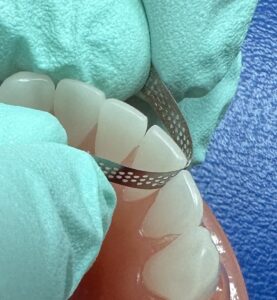
- Use flexible, diamond-coated polishing strips
- Avoid the use of high-speed diamond burs for IPR
- Limit IPR to areas with good access, such as the first premolar to first premolar
- Avoid IPR at the posterior or back teeth where access is poor
- Avoid IPR for patients with a sensitive gag reflex
IPR is a non-extraction method of gaining space in a dental arch is not limited to Invisalign therapy.
IPR technique can be used in fixed braces, lingual braces, or aligner therapy.
Our Drs at MyBracesClinic are a conservative lot and prefer to use interdental, thin, diamond-coated strips that wrap around the sides of your teeth to perform IPR.
This is often done by hand and, in some instances, using a thin 0.15mm diamond wheel.
IPR is a very fast procedure with no downtime. Local anesthetic is often not needed at all.
Patients often describe the feeling of IPR like getting a mani or pedicure, sometimes even ticklish.
Most patients do not feel any different after IPR.
Here are some things you may feel after IPR is done between teeth:
- Some patients may be able to see a very small space at the IPR site
- Mild, transient increase in tooth mobility
- Food trap until the IPR space closes
- Mild, transient redness at the gum area
- Mild, transient sensitivity of the gums and teeth
Pain is not expected after IPR. Please give teeth time to move into place.
It is a good idea to do the following after IPR is done between teeth:
- Avoid sour/ acidic food and drink for 2-3 days
- Avoid extreme temperature food/ drink such as ice cream and hot soups for 2-3 days
- Keep the teeth with IPR clean
- Floss regularly and use a fluoride-containing toothpaste
- Avoid food getting stuck in the IPR space, as teeth need to move into the space created
- Avoid playing or nudging teeth with IPR, as mild, transient tooth mobility is expected
- Pain is not expected after IPR, but if you have mild sensitivity, you may take light painkillers for 2-3 days.
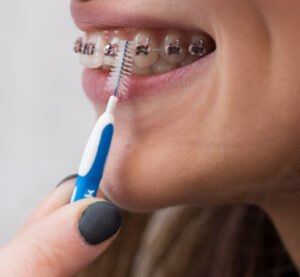

Non-Extraction Solutions | Avoiding Extraction