





- Dr Duan Duoni
- For patients
- 10 min read
And what your retainer is quietly doing every night
Teeth move back after braces because they were never fixed in place to begin with. They sit in living bone, held by fibres and surrounded by muscles, and all of these keep nudging them long after treatment ends.
One of the most common messages we get goes something like this: “I had braces as a teenager, stopped wearing my retainer at university, and now my bottom teeth are crooked again. Did my braces fail?”
Usually, no. The braces did their job. What happened next is biology, and once you understand it, retainers stop feeling like an afterthought and start making a lot of sense.
Teeth are not set in concrete

Source: Curaprox
It’s easy to picture teeth as posts cemented into the jaw. In reality, each tooth is suspended in its socket by a thin cushion of fibres called the periodontal ligament.
That ligament is what makes orthodontics possible in the first place. When braces or aligners apply a gentle, steady force, the bone on one side of the root is broken down and new bone is laid down on the other. The tooth moves through the bone, a fraction of a millimetre at a time.
The catch is that this system never switches off. The same biology that let us move your teeth into a better position will also let them drift out of it.
Four reasons teeth drift
1. The fibres around your teeth have a memory. During treatment, the ligament around each root widens and its fibres are disrupted, which is why teeth feel slightly loose with braces on. Once the braces come off, these fibres reorganise at different speeds. A classic study by Reitan (1967) found the ligament fibres settle in about 3 months and the collagen fibres in the gums in about 6 months. The elastic fibres just around the neck of the tooth can take over a year. Until then, they keep pulling the tooth back towards where it started. This is why rotated teeth are the most likely to relapse.
Source: Invisalign
2. Your lips, cheeks and tongue never stop pushing.

Source: Invisalign
2. Your lips, cheeks and tongue never stop pushing. Teeth sit in a “neutral zone” between the tongue on the inside and the lips and cheeks on the outside (Proffit, 1978). Light but constant resting pressure from these muscles largely decides where teeth settle. A few things can tip that balance:
- Lips: if the lips can’t close comfortably, or the upper front teeth sit outside the control of the lower lip, protruding teeth are more likely to flare forward again. A tight lower lip can tip front teeth back.
- Tongue: most forward tongue thrusts are adaptive. With an open bite, the tongue pushes forward to seal the gap, and it usually settles once the bite is closed. A true, inborn tongue thrust is rare, but when present it makes the result much harder to hold.
- Habits: thumb sucking, mouth breathing and similar habits can undo treatment if they continue.
- The frenum: a thick band of gum tissue between the upper front teeth can help a closed gap reopen. Sometimes we suggest a small procedure (frenectomy) to release it, though a retainer is still needed afterwards.
4. Movemints Clear Aligner Mints
3. Teeth remember their old arch shape. Long-term studies show the dental arch tends to drift back towards its original shape after retention ends. In general, the bigger the change we make, the stronger the pull back, although people vary a lot. This is why we’re cautious about widening the lower arch, especially across the canines, and why your starting arch form is one of the best guides to what will stay stable. A well-fitting bite helps too, but a perfect bite at the end of treatment doesn’t guarantee long-term stability on its own.

Source: Amazon
5. OrVance Aligner Pontics

Source: Orvance
4. Faces keep growing and changing, for decades. This is the one most people don’t expect.
- Teenagers: growth often continues in the same pattern that caused the original problem. That’s why some cases, like a protruding or underbite jaw or an open bite, need closer monitoring and sometimes special retainers during the late teens.
- Adults: growth slows but doesn’t stop. Studies have followed people into their forties and found the face and jaws still changing slowly, mostly in the same direction as before (Behrents, 1985). As the lower jaw changes, the lower front teeth tend to tip back and crowd to compensate.
- Everyone: the width between the lower canines naturally narrows with age, even in people who never had braces (Sinclair & Little, 1985). A 40-year follow-up study found that crowding corrected by braces tended to return in the long term, while the overall bite correction stayed stable (Freitas et al., 2021).
That last point matters. Some movement after braces isn’t a treatment failure. Everyone’s teeth change with age, and retainers are the main way to hold that off.
What retainers actually do
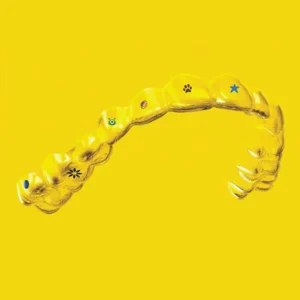
A retainer doesn’t move teeth. Its job is simply to hold them still while the fibres settle, and then to keep resisting the slow pressures of everyday life. There are two main types.
Many of our patients have both: a fixed wire behind the lower front teeth and a removable retainer for night-time wear.
Which is better? The research doesn’t crown a clear winner. What matters most is choosing the one you’ll actually look after, and coming in for checks so any problems are caught early.
Extra steps that can help
For teeth at higher risk of relapse, we sometimes add one of these to the plan:
- Overcorrecting rotations early: turning a rotated tooth slightly past its final position early in treatment, then holding it there for longer before the braces come off.
- Fibrotomy: a minor gum procedure that releases the stretched fibres around a rotated tooth. Long-term studies show it reduces rotational relapse, particularly for the upper front teeth, without harming the gums (Edwards, 1988).
- Gentle enamel reshaping: polishing a tiny amount of enamel between the lower front teeth makes their contacts broader and flatter, so they are less likely to slip past each other.
To be clear about the evidence: a 2023 systematic review found that support for these add-ons is still limited (Al-Moghrabi et al., 2023). They work alongside a retainer, not instead of one.
So how long do I need to wear it?
The short answer: for as long as you want your teeth to stay straight.
That can sound daunting, but it usually looks like this in practice:
- The first 3 to 4 months: wear your removable retainer full-time. The ligament fibres are still reorganising, so this is when teeth move most easily.
- Up to at least 12 months: wear it every night. The gum fibres around rotated teeth can take over a year to settle.
- Long term: most people move to wearing it a few nights a week, indefinitely.
A useful self-check: if your retainer feels tight when you put it in, your teeth were starting to move. Wear it more often until it goes on comfortably again. If it no longer fits at all, don’t force it in. Get in touch with us instead.
What we recommend depends on how much has moved and what bothers you:
- Minor movement: sometimes a new retainer, or a short course of clear aligners, is enough to bring things back.
- More noticeable changes: a fuller course of treatment may be worth considering, followed by a retention plan that fits your lifestyle this time.
- A broken or loose fixed retainer: book in sooner rather than later. A wire that has come unstuck from one tooth can let that tooth drift, sometimes without you noticing.
The goal isn’t to make you feel guilty about a retainer left in a drawer. It’s to help you keep the result you invested in, with a plan you can realistically stick to.
Final Thoughts
Straight teeth aren’t a one-time fix. They’re a result you keep up, a bit like fitness after training for a race. Your teeth will always respond to the fibres, muscles and slow facial changes around them, and that isn’t a sign anything went wrong. A retainer worn consistently, plus the occasional check-up, is a small daily habit that protects years of treatment. If something feels off, come and see us early. Small changes are much easier to manage than big ones.