




- Dr Duan Duoni
- Fun Facts
- 10 min read
What a 50-year study tells us about how teeth move as we age…
Probably not.
Teeth move throughout life, wisdom teeth or not, and the lower front teeth are the ones that show it most.
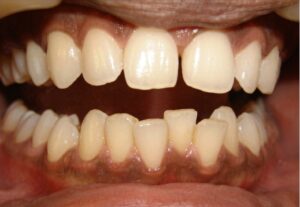
This is one of the questions we hear most often: “My bottom teeth have started to look crooked. Is it my wisdom teeth pushing everything forward? Should I take them out?”
It’s a very reasonable guess. Wisdom teeth come in during our late teens and 20s, which is around the time many people first notice crowding.
But a study that followed the same people for 50 years points to a different explanation, and it applies to everyone
Following the same smiles for 50 years
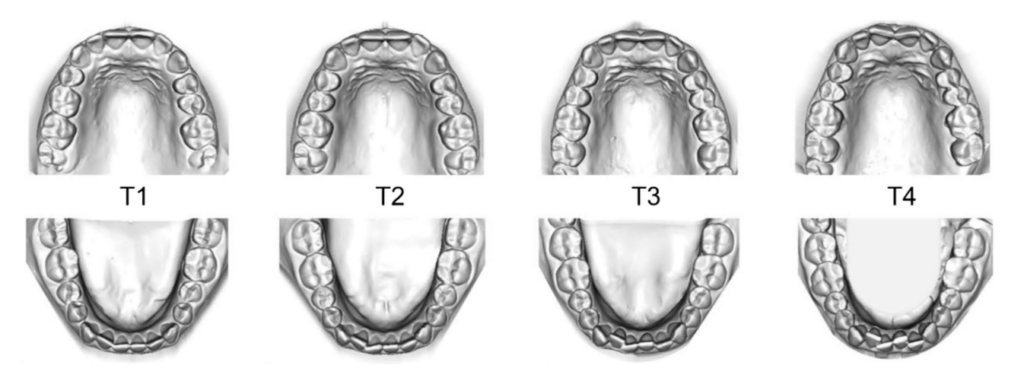
One person’s teeth at ages 13, 16, 31 and 62. Over time, the arch gets shorter and the lower front teeth become more crowded, even though this person never had braces.
In 1965, researchers in Umeå, Sweden, took dental moulds of 30 thirteen-year-olds. They took them again at 16, at 31, and finally in 2014, when the participants were 62 (Basim et al., 2026).
What makes this group special is who they were:
- They all started with good bites and almost no crowding.
- None of them ever had braces or retainers.
- No teeth were removed in front of the second molars during the study.
So any changes they saw weren’t relapse after braces, or teeth shifting into a gap. It was simply what happens to teeth over a lifetime. The old moulds were digitally scanned so the changes could be measured to a fraction of a millimetre.
How teeth change between 13 and 62
Teeth slowly drift forward, the lower arch gets narrower and shorter, and the lower front teeth crowd. The changes are small each year, but they add up.
What changed | Age 13 to 62 |
|---|---|
Lower front teeth crowding | Increased by 2.9 mm on average (more than doubled) |
Length of the dental arch | Shorter by 3.7 mm (upper) and 4.3 mm (lower) |
Width across the lower canines | Narrower by 1.3 mm |
Space for the lower front teeth | Went from enough room to about 2 mm short |
Overbite (vertical overlap of front teeth) | Reduced by 1.1 mm |
Overjet (how far upper teeth sit in front) | Stable after age 16 |
Visible tooth height | Taller, by up to 2.6 mm (upper canines) |
The biggest takeaway is in that first row. These were people who started with straight teeth and never had braces, yet by 62 their lower front teeth had become more crooked.
And it didn’t happen all at once. The changes were steady between every visit: teens, thirties and sixties.
So why do the lower front teeth crowd?
The researchers point to a few things working together:
1. Teeth naturally creep forward.
Most back teeth are angled slightly forward in the jaw. Every time you bite and chew, part of that force nudges them towards the front of the mouth. This slow, lifelong movement is called mesial drift.
When the back teeth inch forward, the arch gets shorter. The front teeth are still the same size, so they have less room and start to overlap.
2. The front of the lower arch narrows.
The distance between the lower canines shrinks with age. That’s the narrowest, tightest part of the mouth, so even a millimetre makes a visible difference to the four teeth sitting between them.
3. The lips, cheeks and tongue keep shaping things.
As we explained in Why Do Teeth Move Back After Braces?, teeth sit in a balance between the tongue on the inside and the lips and cheeks on the outside. That balance shifts slowly as our faces age, and the teeth follow.
None of this is a sign that something has gone wrong. It’s the normal biology of a mouth that’s been working for decades.
So what about wisdom teeth?
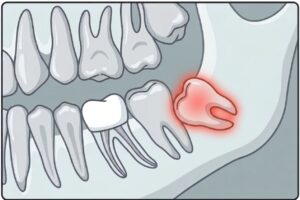
Research has found only a weak link between wisdom teeth and late crowding of the lower front teeth (Richardson, 1989).
The timing makes them an easy suspect. But crowding develops in people whose wisdom teeth never came through, people who had them removed, and people who never had them at all. In the 50-year study, crowding kept increasing well into the participants’ sixties, long after any wisdom teeth would have finished erupting.
That doesn’t mean wisdom teeth never need attention. There are good reasons to remove them, such as decay, repeated gum infections, cysts, or damage to the tooth in front. Your dentist or oral surgeon can advise on that.
But removing healthy wisdom teeth just to stop the front teeth from crowding usually won’t achieve that. The forces at work come from the whole mouth, not from the back of it.
What this means if you’ve had braces
The same changes happen whether or not you’ve had orthodontic treatment. That’s why it can be hard to tell “relapse” apart from normal ageing. Often, it’s a bit of both.
The good news is that a retainer holds against both. It can’t stop your face from ageing, but it keeps your teeth from following along.
A few practical points:
- Keep wearing your retainer long term. For most people, a few nights a week is enough once the first year is over.
- If your retainer feels tight, your teeth were starting to move. Wear it more often until it fits comfortably again.
- Check fixed retainers at your dental visits. A wire that has come loose from one tooth can let it drift without you noticing.
- If you never had braces and your lower teeth are slowly crowding, that’s common. Whether to treat it depends on how much it bothers you and whether it affects cleaning or your bite.
If you’ve noticed changes, come and see us. Small changes are much easier to correct than big ones, sometimes with just a new retainer or a short course of aligners.
A note on the evidence
To be clear about the study’s limits:
- It’s a small group: 30 people at the start and 21 by age 62. Long studies like this are rare because people move away or lose teeth over five decades.
- Everyone started with a good bite. People who begin with crowding or bite problems may change differently.
- The participants were Swedish. Arch shapes and growth patterns vary between populations, so the exact numbers may differ for Singaporeans.
- Averages hide variation. Some people changed a lot, others very little.
- Even so, the overall pattern matches decades of earlier research. Teeth keep changing for life.
Final Thoughts
Your wisdom teeth probably aren’t the villain.
Teeth are living parts of a living face. They drift forward, the arch narrows, and the lower front teeth crowd a little more each decade, whether or not wisdom teeth are in the picture.
That isn’t something to worry about. It’s something to plan for. A retainer worn consistently is still the simplest way to keep your smile where you want it.
Your teeth will keep moving. Let your retainer have the final say! 😉